CA-13/09/2025
Gyan Bharatam mission
Why in news?
Gyan Bharatam mission officially launched with the first Gyan Bharatam International Conference held from September 11 to 13, 2025, at Vigyan Bhawan, New Delhi.
About Gyan Bharatam Mission
- The Gyan Bharatam Mission is a comprehensive national initiative launched in the Union Budget 2025-26 under the Ministry of Culture, aimed at preserving, digitizing, and globally disseminating India’s vast manuscript heritage.
- It builds on the foundation of the National Mission for Manuscripts and integrates modern technology, including Artificial Intelligence (AI), to safeguard ancient knowledge systems for future generations.
- Survey, Documentation, and Cataloguing: Systematic nationwide identification and cataloguing of more than one crore manuscripts from academic institutions, museums, libraries, and private collections to create a reliable national register.
- Conservation and Restoration: Scientific and traditional methods to conserve fragile manuscripts through strengthened Manuscript Conservation Centres.
- Digitization and Repository Creation: Large-scale AI-assisted digitization using Handwritten Text Recognition, microfilming, and cloud-based metadata systems to create a National Digital Repository accessible globally.
- Research, Translation, and Publication: Reviving rare and unpublished manuscripts through critical editions, facsimiles, translations in multiple languages, and integration into education and research.
- Technology and Innovation: Initiatives like the Gyan-Setu AI Innovation Challenge encourage the use of AI and technology for heritage preservation and innovation.
- Capacity Building: Training scholars and specialists in manuscriptology and related fields to sustain and promote knowledge.
- Global Collaboration: Promoting academic and cultural collaborations to share and expand access to India’s civilisational knowledge.
- Gyan Bharatam Portal: Includes digital platforms and a dedicated Gyan Bharatam Portal for manuscript access and sharing.
- Supports Article 51A(f) fundamental duty to preserve cultural heritage.
- Aligns with the National Education Policy (NEP) 2020 by integrating Indian Knowledge Systems into modern education.
- Bridges the gap between India’s heritage and modern technology, empowering youth and promoting India's cultural leadership worldwide.
- Provides wider public access to rare texts, boosting research, innovation, and cross-cultural scholarship.
Viksit Krishi Sankalp Abhiyan
Why in news?
Viksit Krishi Sankalp Abhiyan highlights that the campaign is entering its second phase starting October 3, 2025, focusing on Rabi crops after successful completion on kharif crops.
About "Viksit Krishi Sankalp Abhiyan" (also referred to as "Viksit Bharat Sankalp Abhiyan" in agriculture context)
- It aims to modernize Indian agriculture through scientific outreach, sustainable practices, and farmer empowerment.
- The campaign is conducted biannually before the Kharif and Rabi sowing seasons, providing timely field-level guidance on improving crop production, soil health, and resource management.
- It targets over 65,000 villages across 723 districts, directly engaging more than 1.3 crore farmers to adopt scientific farming practices.
- It aligns with the vision of making India the "Food Basket of the World" through climate-resilient, science-backed, and farmer-centric agriculture.
- Organized by the Ministry of Agriculture & Farmers Welfare, Indian Council of Agricultural Research (ICAR), State Agriculture Departments, Krishi Vigyan Kendras (KVKs), and Farmer Producer Organizations (FPOs).
- Initiatives highlighted in the campaign include solar panels on field boundaries, beekeeping (Sweet Revolution), converting agricultural residue into energy, and value addition in agricultural produce.
- The campaign reinforces the vision of India becoming a developed nation with agriculture as a cornerstone, urging scientists and officials to treat their work as national service.
The Viksit Bharat Sankalp Abhiyan is a comprehensive outreach and modernization effort aimed at transforming Indian agriculture through scientific, technological, and policy support to farmers, contributing to India's development goals in agriculture and food security.
INS Trikand
Why in news?
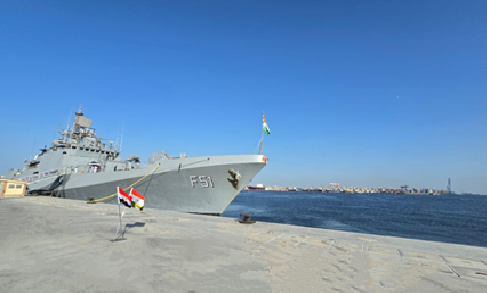
INS Trikand arrived at Salamis Bay, Greece on September 13, 2025, marking its participation in the first-ever bilateral maritime drill between India and Greece, strengthening India's maritime partnerships and global security initiatives.
About INS Trikand
- INS Trikand is a frontline, stealth Talwar-class guided missile frigate of the Indian Navy, equipped for a range of advanced maritime missions.
- Displacement: 4,000 tonnes
- Complement: 257 personnel including officers, sailors, and marine commandos
- Stealth features: Special hull design reduces radar, magnetic, and acoustic signatures
- INS Trikand is part of the Western Fleet, based in Mumbai, and undertakes a wide spectrum of naval operations including anti-ship, anti-air, and anti-submarine missions.
Armament and Sensors
- Missiles: 8 BrahMos supersonic cruise missiles, 32 Barak 8 surface-to-air missiles.
- Guns: 4 AK-630 rapid-fire naval guns, A190 medium-range gun, Close-in Weapon System.
- ASW (Anti-submarine Warfare): Torpedo tubes, hull-mounted and towed array sonar, ASW helicopters
- Advanced Sensors: MF-STAR phased array radar, electronic warfare suite, combat management system ‘Trebovanie-M’ for simultaneous multi-threat engagement.
- Helicopters: Capable of operating a Kamov 31 helicopter.
- The second batch of Talwar-class ships, including INS Trikand, swapped Klub-N missiles for the BrahMos system for enhanced firepower.
DSC A22
Why in News?
Recently DSC A22 launched on 12 September 2025 at Titagarh, Kolkata. DSC A22 is the third ship in a series of five Diving Support Crafts (DSC), built indigenously by Titagarh Rail Systems Ltd (TRSL) for the Indian Navy.
Key Details
- Purpose: Specialized for diving operations in coastal waters, including submarine rescue, underwater inspection, salvage, and object recovery.
- Displacement: Approximately 380 tonnes.
- Compliance: Built under Indian Register of Shipping (IRS) naval rules; hydrodynamic testing and model analysis conducted at NSTL Visakhapatnam (DRDO lab).
- Indigenization: Fully designed and constructed in India as part of the Make in India and Aatmanirbhar Bharat initiatives.
- DSC A22 (Yard 327) is the third in the series; two more (A23, A24) are under construction.
Strategic Importance
- Enhances the Navy's ability for on-site underwater rescue, hull cleaning, training, and maintenance in critical infrastructure areas.
- Dedicated platforms like DSC A22 address growing underwater threats in the Indian Ocean Region and operational safety near naval bases and harbours.

