CA-27/08/2025
Contents
1. Collegium System
2. Vice Presidential election
3. Road Asset Mapping Application
Collegium System
Why in news?
The collegium system for judicial appointments in India is currently in the spotlight due to internal dissent within the Supreme Court regarding recent elevation recommendations.
Justice B.V. Nagarathna has strongly dissented against the collegium's move to elevate Patna High Court Chief Justice Vipul M. Pancholi to the Supreme Court, citing concerns about regional representation and precedent-setting.
Ongoing Debates and Controversies
- Transparency and Objectivity: Critics argue the collegium system is opaque and lacks accountability. The system is an outcome of Supreme Court judgments, not a constitutional requirement, and is often criticized for internal favoritism and insufficient consideration of merit across all High Courts.
- Calls for Reform: There continue to be strong demands for an overhaul. The Vice President and several legal commentators have raised objections, suggesting that greater executive or public involvement and transparent procedures are needed to ensure judicial independence without arbitrariness.
- Context of Delays and Criticism: Recent years have also seen executive-judiciary clashes, delays in appointments and transfers, and public criticisms of the collegium system by government officials. However, the Supreme Court has reiterated that the collegium process remains the binding law until changed formally.
The collegium system is the process by which judges are appointed and transferred in the higher judiciary, primarily in the Supreme Court and High Courts, through decisions made by a group of the Chief Justice of India and the four senior-most judges of the Supreme Court—forming what is known as the "Collegium".
Historical Evolution
- The collegium system evolved through three landmark Supreme Court judgments: the First Judges Case (1981), Second Judges Case (1993), and Third Judges Case (1998).
- The system was designed in response to concerns over executive overreach and to ensure judicial independence, especially after the excesses witnessed during the Emergency period (1975–77).
- In the Second Judges Case (1993), the term "consultation" in constitutional provisions was interpreted as "concurrence", making the executive bound by the collegium's recommendations for judicial appointments.
- The Collegium for Supreme Court appointments comprises the Chief Justice of India (CJI) and the four most senior Supreme Court judges. For High Court appointments, it involves the CJI and two senior-most judges.
- The Collegium recommends names to the Central Government for judicial appointments and transfers. The government may return names for reconsideration, but if the collegium reiterates a recommendation, the government is constitutionally obliged to accept it.
- No constitutional or statutory basis: The collegium system is not explicitly mentioned in the Constitution or any law; it is a product of judicial interpretation.
- Ensures judicial primacy: The judiciary, not the executive or legislature, effectively has the final say in appointments to the higher judiciary.
Criticisms and Controversies
- Lack of transparency and accountability: The process of selection is viewed as opaque, with little public information on criteria and reasons for appointments.
- Claims of nepotism and lack of diversity: Critics highlight the prevalence of the so-called "uncle judge syndrome"—where many appointees are related to established legal luminaries—and underrepresentation of women, Scheduled Castes, and other marginalized communities.
- Slow pace and executive-judiciary tussles: Delays in appointments often lead to vacancies and friction between the judiciary and the executive branches.
- Attempts to reform the system through the National Judicial Appointments Commission (NJAC) via a constitutional amendment were struck down as unconstitutional in 2015, reaffirming the collegium's primacy.
- Calls for reform continue, focusing mainly on increasing transparency, accountability, and social diversity within the judiciary.
| Article | Scope |
|---|---|
| Article 124 | Deals with the appointment of Supreme Court judges by the President after consultation with such judges as deemed necessary. The Chief Justice of India must be consulted for every appointment except his or her own. |
| Article 217 | Relates to appointment of High Court judges by the President, in consultation with the Chief Justice of India, the Governor of the state, and the Chief Justice of the concerned High Court (for others, not for CJI). |
Important Points
- These articles provide the constitutional foundation for judicial appointments, but do not mention the collegium system—which evolved through the First, Second, and Third Judges Cases as an interpretation of these articles to safeguard judicial independence.
- The Supreme Court, through its judgments, interpreted the word "consultation" in these articles to mean "concurrence," making the judiciary’s view binding on the executive with respect to appointments and transfers.
- Article 222: Concerns the transfer of High Court judges.
- Article 50: Under Directive Principles, it aims to separate the judiciary from the executive to ensure independence.
Vice Presidential election
Why in news?
The 2025 Vice Presidential election in India is scheduled for September 9, 2025, following the resignation of Jagdeep Dhankhar due to health concerns.
Election of Vice President
The Vice President of India is elected indirectly by an electoral college consisting of members of both Houses of Parliament (Lok Sabha and Rajya Sabha, including nominated members) through a system of proportional representation using the single transferable vote and secret ballot.
Eligibility
- The candidate must be a citizen of India.
- The candidate must have completed 35 years of age.
- The candidate must be qualified to be elected as a member of the Rajya Sabha.
- The candidate must not hold any office of profit under the Government of India, any state government, public authority, or local authority.
- The candidate should not be a member of either House of Parliament when assuming office as Vice President; if elected while holding such a seat, that seat is deemed vacated on taking office.
- Electoral college: all members of both Houses of Parliament (elected and nominated)
- Voting system: proportional representation by single transferable vote
- Required nomination: supported by at least 20 MPs as proposers and 20 as seconders
- Security deposit: ?15,000
- Election conducted by the Election Commission of India
- Elections held before the expiration of the outgoing Vice President’s term or as soon as possible after a vacancy arises
- Ex-officio Chairperson of Rajya Sabha
- Acts as President during casual vacancies or when the President is unable to perform duties (limited to max 6 months)
- Presides over Rajya Sabha sessions (except while acting as President)
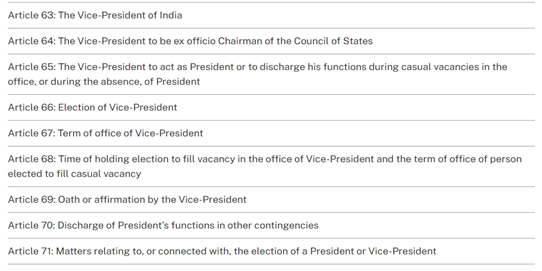
- Discharges legislative and contingent executive functions as defined by Constitution Articles 63, 64, and 65
- Authority to initiate removal: Only Rajya Sabha.
- Majority required in Rajya Sabha: Effective majority (majority of all then members).
- Approval by Lok Sabha: Simple majority.
- Notice period: At least 14 days' advance notice before moving the resolution.
- Grounds for removal: Not specified in the Constitution.
- Impeachment: Unlike the President, the Vice President does not have a formal impeachment procedure.
- Supreme Court role: It can remove the Vice President for election malpractices or if found ineligible under election law provisions.
Road Asset Mapping Application
Why in news?
The Delhi government is set to launch a Road Asset Mapping Application aimed at real-time monitoring and effective management of key roads in the capital.
Key highlights:
- Real-time monitoring of roads with a digital inventory of road assets.
- Identification and monitoring of black spots and encroachments on roads.
- Integration with a centralized dashboard for better oversight.
- Assembly-wise reporting to improve accountability.
- Supplementary systems like a dark spot monitoring platform for streetlights to ensure faster repair.
- A real-time dashboard for tracking and resolving pothole and waterlogging complaints.
- Project Monitoring System for tracking progress on major road and infrastructure projects with over Rs 1 crore investment to ensure transparency and timely completion.
- This initiative is part of the Public Works Department's effort to leverage technology to enhance road infrastructure, safety, and municipal responsiveness in Delhi.
- Public Works Department (PWD): Providing real-time updates and progress reports on road and infrastructure projects.
- Delhi Police: Feeding information related to road safety issues and streetlight outages through the Dark Spot Monitoring System.
- Municipal Corporations and Local Bodies: Supplying data on road encroachments, maintenance, and citizen complaint management.
- Elected Representatives: Contributing reports and feedback on road conditions and safety from their constituencies.
- Other Government Agencies involved in urban infrastructure and maintenance, supporting comprehensive data collection for grievance redressal related to potholes, waterlogging, and road asset conditions.
Download Pdf

