CA-26/08/2025
Contents
1. Lunar Module Launch Vehicle (LMLV)
2. Integrated Air Drop Test (IADT-01)
3. INS Udaygiri and INS Himgiri
4. India-Fiji relations
Lunar Module Launch Vehicle (LMLV)
Why in news?
ISRO is developing its heaviest and most powerful rocket aimed at supporting lunar missions,
About
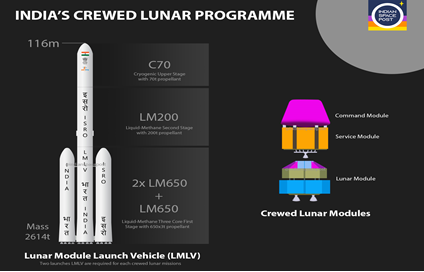
The Lunar Module Launch Vehicle (LMLV) is the Indian Space Research Organisation’s (ISRO) heaviest and most powerful rocket in development, projected to be ready by 2035. Designed specifically for lunar missions, it will support India's first human Moon mission planned for 2040.
Key aspects of the LMLV include:
- Payload capacity: 80 tonnes to LEO and ~27 tonnes to lunar orbit.
- Design: Three stages (2 liquid propellant stages + 1 cryogenic stage), 27 engines in the first core cluster.
- Scale: Height equivalent to a 40-storey building; strap-on boosters taller than current rockets.
- Purpose: To enable crewed lunar missions, transport lunar habitats and cargo for long-duration lunar presence.
- Timeline: Expected readiness by 2035, lunar human missions by 2040.
- Strategic role: A crucial heavy-lift vehicle for India's deep space ambitions, complementing the enhanced LVM3 for space station module launches.
- Shift from NGLV: NGLV development dropped; LMLV focuses on lunar missions, while LVM3 upgrades support Bharat Antariksh Station modules.
Integrated Air Drop Test (IADT-01)
Why in news?
The Indian Space Research Organisation (ISRO) successfully conducted its first Integrated Air Drop Test (IADT-01) for the Gaganyaan mission on August 24, 2025, at the Satish Dhawan Space Centre in Sriharikota.
The test was a collaborative effort among ISRO, DRDO, Indian Air Force, Indian Navy, and Indian Coast Guard.
About the Test
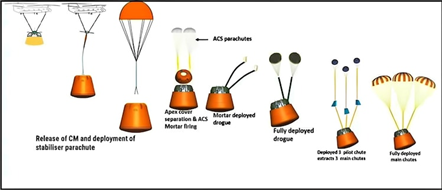
- It involved dropping a 4.8-ton simulated Crew Module from about 3.1 km altitude using an Indian Air Force Chinook helicopter over the Bay of Bengal.
- The objective was to validate the entire parachute-based deceleration system for the crew module, crucial for safe splashdown and astronaut recovery.
- This was a critical system-level qualification test for the crew module’s parachute system, which ensures safe re-entry and recovery of astronauts.
- It involved coordinated efforts from ISRO, DRDO (which designed the parachute system), Indian Air Force, Indian Navy, and Indian Coast Guard.
- The test verified parachute deployment under real flight conditions and validated onboard avionics and data telemetry.
- Gaganyaan aims to send a crew of three astronauts to a 400 km orbit for a 3-day mission with safe return to Earth.
- The air drop test is a major milestone in preparing for the first uncrewed mission planned by end of 2025 and the first crewed mission planned for late 2027.
- The parachute system is vital for reducing the descent velocity of the crew module during splashdown.
- This integrated air drop test is one of several planned tests to fully qualify the parachute system under various deployment conditions ahead of the Gaganyaan human spaceflight missions.
INS Udaygiri and INS Himgiri
Why in news?
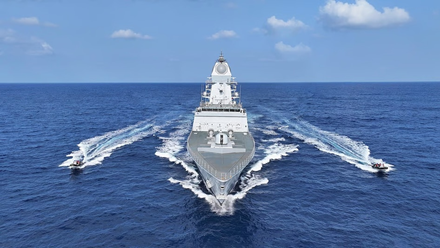
INS Udaygiri was commissioned along with INS Himgiri on 26 August 2025 at Naval Dockyard, Visakhapatnam.
About
INS Udaygiri and INS Himgiri are advanced stealth guided-missile frigates of the Indian Navy, built under Project 17A (Nilgiri-class), representing a significant leap in indigenous warship design with around 75% local content. They are multi-mission platforms capable of anti-air, anti-surface, anti-submarine warfare, and land-attack roles, boosting India’s maritime strike and defense capabilities.
INS Udaygiri Key Highlights
- Built by Mazagon Dock Shipbuilders Limited (MDL), Mumbai; second ship of Project 17A.
- Displacement: About 6,700 tonnes.
- Advanced stealth design minimizing radar, infrared, and acoustic signatures.
- Propulsion: Combined Diesel or Gas (CODOG) system.
- Armament includes BrahMos supersonic anti-ship missiles, Barak 8 surface-to-air missiles, a 76 mm main gun, Close-In Weapon Systems, and advanced anti-submarine warfare weapons.
- Indigenous content around 75%, with over 200 MSMEs involved and nearly 4,000 direct jobs created.
- Marked as the 100th vessel designed by the Navy’s Warship Design Bureau.
- Fast construction timeline: laid down Dec 2017, launched May 2022, delivered July 2025.
- Built by Garden Reach Shipbuilders and Engineers (GRSE), Kolkata; first Project 17A frigate from this yard.
- Displacement: About 6,670 tonnes; length: 149 meters.
- Enhanced stealth features to reduce radar and infrared signatures.
- Propulsion: CODOG system with speeds over 28 knots.
- Armament includes BrahMos missiles, Barak 8 air defense system, Close-In Weapon Systems, anti-submarine rocket launchers, torpedo tubes, and advanced electronic warfare systems.
- Equipped with MF-STAR AESA radar, BEL HUMSA-NG sonar, and Ajanta electronic warfare suite.
- Aviation capabilities with flight deck and hangar supporting MH-60 Romeo, ALH Dhruv Mk-III, and Sea King helicopters.
- Around 75% indigenous content.
- Launched in Dec 2020, delivered July 2025, continuing the legacy of the original INS Himgiri (1974–2005).
- Both ships have reduced radar cross-sections, composite superstructures, and flush-mounted systems to enhance stealth.
- They operate with a Combined Diesel or Gas (CODOG) propulsion system and an Integrated Platform Management System (IPMS) for automation.
- Their commissioning is a milestone in India's defense self-reliance, modular shipbuilding, and naval modernization.
- These frigates strengthen India’s ability to operate across the Indian Ocean, enhancing maritime security and power projection.
- This simultaneous commissioning at Visakhapatnam marks a new era of operational capability and naval autonomy for India.
India-Fiji relations
Why in news?
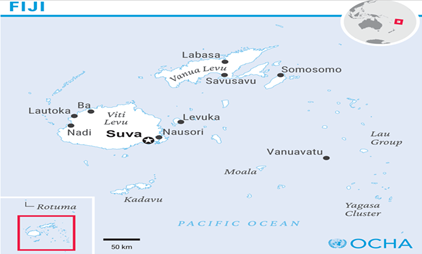
The Fiji's Prime Minister Sitiveni Rabuka visit to India from August 24 to 26, 2025 highlights a significant milestone in India-Fiji relations.
Key Developments from the Visit
- A MoU was signed for the establishment of a super-specialty hospital in Fiji, enhancing healthcare infrastructure with Indian support.
- Agreements were made for affordable medicine supply through India's Janaushadhi scheme, standardization partnerships, and digital skilling initiatives.
- India pledged to send a cricket coach to Fiji to boost sports ties and will also support sugar industry modernization through agricultural drones and mobile soil testing labs.
- Defense cooperation has been expanded with a new action plan covering maritime security, cyber defense, training, and equipment supply. India announced the establishment of a Defense Attaché post in its High Commission in Fiji and gifted ambulances to Fiji’s military forces.
- India and Fiji committed to strengthening maritime security, counterterrorism cooperation, and humanitarian assistance.
- Fiji joined India’s Indo-Pacific Oceans Initiative (IPOI), aligning with strategic regional cooperation.
- Provisions for cultural and educational collaboration include sending a Hindi-cum-Sanskrit teacher to the University of Fiji and training cohorts of Fijian pundits in India.
- Diplomatic infrastructure was enhanced with the formal handing over of the lease deed for the Indian Chancery building in Suva.
- The visit and the agreements indicate India’s deepening footprint in the Pacific region, positioning Fiji as a key strategic partner in the Indo-Pacific under the Forum for India-Pacific Islands Cooperation (FIPIC) framework.
- Strengthening defense and security ties comes against a backdrop of regional power dynamics, with increased emphasis on Indo-Pacific maritime security and counterterrorism cooperation.
Historical and contemporary development
- India-Fiji relations have a rich historical background that began in 1879 when the first Indian laborers, known as Girmitiyas, were brought to Fiji under the British indenture system to work primarily on sugarcane plantations.
- Over the next four decades, around 60,553 Indians were brought to Fiji, laying the foundation for a significant Indian diaspora that today makes up about 37% of Fiji's population.
- This community has played a vital role in the cultural, social, and political landscape of Fiji, serving as a key bridge in bilateral ties between the two countries.
- India established diplomatic representation in Fiji early on, beginning with a Commissioner’s post in 1948, which was upgraded to a High Commission after Fiji's independence in 1970.
- Fiji reciprocated by establishing its High Commission in New Delhi in 2004.
- Despite disruptions such as the closure of India's High Commission following political instability in Fiji in the late 1980s, relations were resilient and re-established in the late 1990s and early 2000s.
- High-level visits like Prime Minister Narendra Modi’s 2014 trip to Fiji, India’s first in over three decades, marking a renewed focus on the Pacific through the Forum for India-Pacific Islands Cooperation (FIPIC).
- India's support for Fiji's development through credits for sugar industry modernization, solar energy projects, healthcare, education, and capacity building.
- Military and defense collaboration including agreements to strengthen Fiji’s naval capabilities and stationing of India’s satellite tracking and intelligence facility in Fiji.
Download Pdf

