CA-24/08/2025 and 25/08/2025
Contents
1. Spartly Island
2. Drake Passage
3. Agni-5
4. Lipulekh Pass
5. Integrated Air Defence Weapon System (IADWS)
6. Bloom Syndrome
7. 130th Constitutional Amendment Bill, 2025
Spartly Island
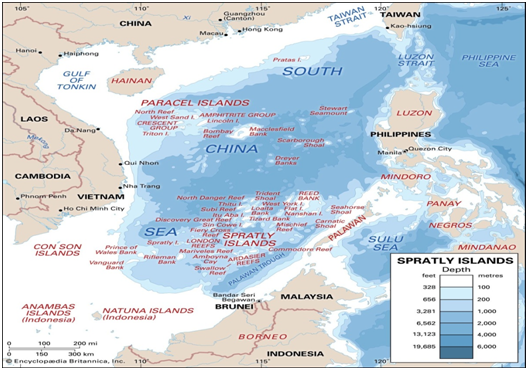
Why in news?
There is a significant acceleration of Vietnam's island-building activities in Spartly Island, with which Vietnam poised to match or even surpass China's extensive land reclamation in the area.
About
- Since early 2025, Vietnam has intensified its land reclamation, extending artificial land to eight previously untouched reefs, including Alison Reef, Collins Reef, East Reef, Landsdowne Reef, and Petley Reef.
- By March 2025, Vietnam had created about 70% as much artificial land in the Spratlys as China, and current activity nearly guarantees Vietnam will soon match or exceed China's reclamation scale.
The Spratly Islands are a large, disputed archipelago of reefs, shoals, atolls, and small islets in the South China Sea, located roughly midway between Vietnam and the Philippines and north of insular Malaysia.
Geographic and Economic Overview
- The Spratly Islands are spread over an area of about 158,000 square miles (409,000 square kilometers), but the land area is tiny, consisting of more than 100 small islands or reefs, many of which are submerged.
- The largest naturally occurring islet is Itu Aba (36 hectares), and another significant feature is Spratly Island (also known as Storm Island), which is 15 hectares.
- The islands have almost no arable land, limited freshwater resources, and no permanent civilian population. Wildlife is mostly restricted to turtles and seabirds.
- Key resources in the area include fish, guano, oil, and natural gas reserves, and the surrounding waters are a major shipping lane.
- The Spratlys are highly contested, with overlapping claims by China, Taiwan, Vietnam, the Philippines, and Malaysia.
- Several countries have built airstrips, harbors, and military outposts, and there is ongoing land reclamation and infrastructure construction, particularly by Vietnam and China.
- The area is strategically crucial due to its location along vital maritime routes and potential energy resources.
- There is escalating land reclamation, especially by Vietnam, which aims to match or surpass the scale of Chinese activities in the region.
- The islands remain a flashpoint for regional security and international maritime law debates, with regular diplomatic tensions among claimants.
- Map detailing the Spratly Islands in the South China Sea, indicating features above high tide (black type) and submerged features (blue type), with a noted erratum for Hughes Reef
- The northeast is called "Dangerous Ground," known for navigation hazards due to many submerged reefs and abrupt coral outcrops.
- Spratly Island (Storm Island), managed by Vietnam, has seen significant land reclamation, expanding to about 36.5 hectares with new harbor and extended runway by 2025.
- The archipelago's official names vary by claimant: for example, Nansha Qundao (China), Kepulauan Spratly (Malaysia), Pangkat Islang Kalayaan (Philippines), and Quan Dao Truong Sa (Vietnam).
Drake Passage
Why in news?
Recently there is a Magnitude 7.5 earthquake in the Southern Drake Passage caused by tectonic activity in a complex boundary region where the South American Plate and Antarctic Plate interact.
The region is marked by numerous faults and fracture zones beneath the seafloor, leading to significant seismic activity.
Specific Factors Behind the Event
- The Drake Passage is located in a tectonically active area that opened millions of years ago due to plate divergence, resulting in prominent fault lines.
- The event's focal mechanism and position indicate it was a strike-slip earthquake, caused by horizontal movement along a fault rather than vertical displacement.
- These types of oceanic intraplate earthquakes happen when built-up tectonic stresses are released along weak zones or pre-existing faults in the plate.
- Although most large earthquakes in this region occur near mapped boundaries like the Shackleton Fracture Zone, this quake took place in an intermediate zone, consistent with a pattern of historic crustal stress.
The Drake Passage is a deep, narrow waterway between Cape Horn at the southern tip of South America and the South Shetland Islands of Antarctica, connecting the Atlantic and Pacific Oceans and serving as the shortest sea route between the two continents.
Geography and Location
- The Drake Passage spans about 800–1,000 km (500–600 miles) wide, with a depth averaging 3,400 meters and reaching up to 4,800 meters in some areas.
- It is the narrowest stretch of the Southern Ocean and forms a climatic transition zone between subpolar South America and polar Antarctica.
- Cross-section of the Drake Passage illustrating its depth profile along with surface water salinity and temperature data
- The passage is named after Sir Francis Drake, but it was first traversed by Dutch navigator Willem Schouten in 1616.
- Historically, it was a critical trade route before the Panama Canal and remains infamous for its treacherous seas, with powerful currents, storms, and massive waves.
- The region is also known as "Mar de Hoces" in Spanish, referencing an earlier (1525) Spanish encounter.
- The Antarctic Circumpolar Current flows unimpeded through the passage, playing a major role in global ocean circulation and climate regulation.
- Its unique geography allows intense mixing of cold Antarctic waters and warmer northern waters, driving powerful eddies and extreme sea conditions.
- Expedition ship crossing the Drake Passage towards Antarctica.
- The Drake Passage is notorious for rough weather, strong westerly winds, and massive, unpredictable waves, posing risks even to modern ships.
- The passage is a habitat for whales, dolphins, seabirds (including albatrosses, petrels), and penguins.
- Its mixing zone is biologically and climatically significant for the Southern Ocean ecosystem.
- Despite its dangers, the passage is the preferred route for ships heading to Antarctica because alternative routes (Strait of Magellan and Beagle Channel) are narrower and equally hazardous.
- Crossing is a notable challenge for explorers, scientists, and tourists heading to Antarctica today.
Agni-5
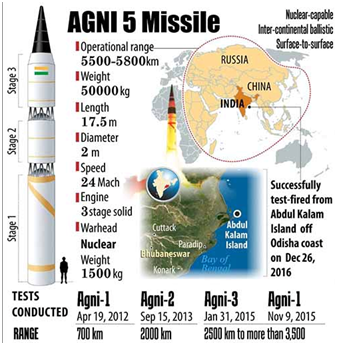
Why in news?
The Agni-5 is India’s most advanced nuclear-capable intermediate-range ballistic missile (IRBM), featuring a range of over 5,000 km, MIRV technology, and road-mobile canisterized launch capability, placing all of China and Pakistan within its reach.
Key Features
- Type: Surface-to-surface, three-stage solid-fuel IRBM, developed by DRDO under the Integrated Guided Missile Development Programme (IGMDP).
- Range: Over 5,000 km, with some estimates and advanced versions suggesting up to 7,000+ km in possible range.
- Warheads: Equipped with Multiple Independently Targetable Reentry Vehicles (MIRV) capability, allowing one missile to carry and deliver three to four nuclear warheads to different targets in a single launch.
- Mobility: Canisterized launch system enables launch from hermetically sealed canisters mounted on road or rail platforms for rapid deployment.
- Navigation and Accuracy: Uses advanced inertial navigation systems, ring-laser gyros, and thrust vector control for high accuracy.
- The Agni-5 marks a leap in India's second-strike and strategic deterrence capability with MIRV technology, placing India among an elite group of nations (USA, Russia, China, France) with such missile technology.
- Its large range places the entirety of China and Pakistan within striking distance, enhancing India’s strategic depth during regional tensions.
- Successful tests in 2024 and 2025, including the MIRV variant, affirm India's operational readiness and robust nuclear posture adhering to the "No First Use" policy.
- Agni-5 is the longest-range missile in the Agni series, complementing shorter-range missiles (Prithvi-2, Agni-1, Agni-2, Agni-3) within the Strategic Forces Command.
- Enhances survivability and operational flexibility due to its mobile, canisterized, and rapid-launch features.
- MIRV (Multiple Independently Targetable Reentry Vehicle) technology enables a single ballistic missile to carry multiple nuclear warheads, each capable of being aimed to hit different targets independently. This technology significantly increases the effectiveness and strategic value of missiles by allowing one missile to engage multiple targets simultaneously, complicating missile defense efforts.
- Other nuclear powers with MIRV technology include Russia, China, the UK, France, and India, while Pakistan reportedly tested MIRVed missiles as well.
Lipulekh Pass
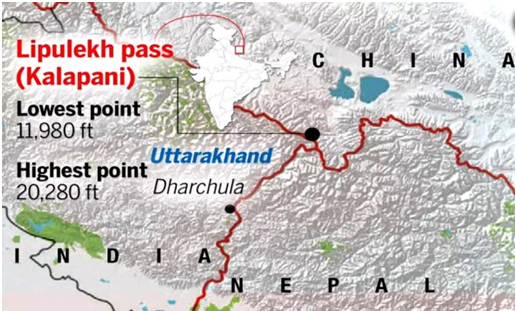
Why in news?
India and China agreed to resume border trade through Lipulekh Pass post-Covid-19, which Nepal objects to diplomatically.
The dispute impacts India-Nepal relations and involves diplomatic discussions, with China remaining neutral in the dispute.
Lipulekh Pass dispute
Location and Claims: Lipulekh Pass is located in Uttarakhand, India, near the tri-junction of India, Nepal, and China. Nepal claims that areas including Lipulekh, Kalapani, and Limpiyadhura belong to its territory, based on historical interpretation of the 1816 Treaty of Sugauli and its constitution. India administers these areas as part of Uttarakhand and rejects Nepal’s claims.
Treaty and Boundary Interpretation: The conflict hinges on the interpretation of the Kali River boundary set by the Treaty of Sugauli. Nepal asserts the river’s origin is at Limpiyadhura, placing disputed territories on their side. India states the river originates downstream near Lipulekh, thus including these territories within India.
Historical Context: India has controlled and administered Lipulekh, Kalapani, and the surrounding regions since the 1962 Sino-Indian War. India also opened the Lipulekh Pass for trade with China since 1954. Nepal’s formal territorial claims emerged later, especially intensifying after 2019 when India released a new political map showing these areas within Indian borders.
Strategic Importance: It serves as a gateway to the higher Himalayas and is strategically valuable for India in terms of security, troop mobility, and monitoring China along the Line of Actual Control (LAC). The pass provides a shorter trade route and access to Kailash Mansarovar in Tibet.
Integrated Air Defence Weapon System (IADWS)
Why in news?
The Defence Research and Development Organisation (DRDO) successfully conducted the maiden flight tests of the Integrated Air Defence Weapon System (IADWS) off the coast of Odisha.
About
- The IADWS is an indigenous multi-layered air defence system developed by Defence Research and Development Organisation (DRDO). It integrates three main components: Quick Reaction Surface to Air Missiles (QRSAM), advanced Very Short Range Air Defence System (VSHORADS) missiles, and a high-power laser-based Directed Energy Weapon (DEW).
- This system provides a comprehensive protective shield against multiple aerial threats including fighters, helicopters, drones, and missiles across different ranges and altitudes.
- QRSAM: A short-range surface-to-air missile system with a range of 3 to 30 km, designed to protect moving armoured columns from enemy aerial attacks. It includes automated command and control, and radars with 360-degree coverage and "search on move" capability.
- VSHORADS: A fourth-generation miniaturized man-portable air defence system effective at ranges between 300 meters and 6 km. It targets drones and various aerial threats and is deployable across Army, Navy, and Air Force.
- DEW (Directed Energy Weapon): A high-power laser weapon with a range of less than 3 km designed to disable or destroy drones and small remotely-piloted aircraft by causing structural damage or sensor disruption.
- The entire IADWS is controlled by a Centralised Command and Control Centre developed by DRDO's Defence Research and Development Laboratory, Hyderabad, enabling coordinated, real-time defence operations.
- The maiden test, conducted off the coast of Odisha in August 2025, successfully engaged and destroyed three different aerial targets simultaneously at different ranges and altitudes.
- IADWS contributes to strengthening India’s multi-layered air defence network, enhancing area defence for critical facilities and augmenting the national security shield being developed under Mission Sudarshan Chakra, with a vision to complete by 2035.
Multi-Layered Defence
IADWS integrates three different types of weapons—Quick Reaction Surface-to-Air Missiles (QRSAM), Very Short Range Air Defence System (VSHORADS) missiles, and a laser-based Directed Energy Weapon (DEW)—creating a comprehensive shield that neutralizes a wide spectrum of aerial threats from high-speed fighter jets and cruise missiles to low-speed drones and loitering munitions within 3 to 30 km range.
Faster and Coordinated Response
The system is controlled by a Centralised Command and Control Centre that enables real-time coordination among its components, allowing simultaneous engagement of multiple targets at different ranges and altitudes with high precision. This integration bolsters response time and interception effectiveness beyond what standalone missile systems offer.
Homegrown Technology and Self-Reliance
All components of the IADWS are indigenously developed by DRDO and associated labs. This reduces dependency on foreign systems, enhances technological sovereignty, and supports India's defence self-reliance, which is crucial for strategic autonomy in critical defence areas.
Versatility and Mobility
The system's components are mobile and configured for deployment with the Army, Navy, and Air Force. VSHORADS is man-portable enhancing flexible defence options, while the QRSAM provides protection for moving armored units. The laser DEW offers a cost-effective, virtually unlimited firing capacity for close-range defence against swarming drones and other UAVs.
Strategic Integration with Mission Sudarshan Chakra
IADWS is a foundational step towards Mission Sudarshan Chakra, a future multi-layered, networked defence shield designed to protect the nation’s borders and critical infrastructure comprehensively. The system's integration with existing air command and control systems promises an enhanced and resilient national air defence network.
The IADWS elevates India's air defence by combining diversified weapon technologies into a unified, responsive, and indigenously developed shield, offering faster interception, broader threat coverage, and strategic autonomy compared to India's current air defence setups.
Bloom Syndrome
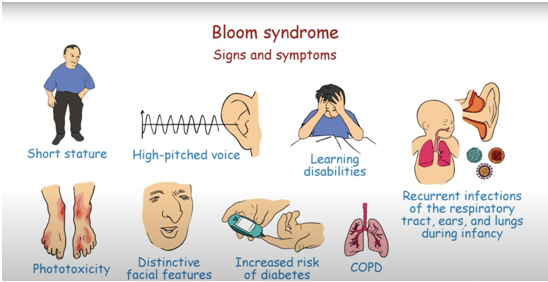
Why in news?
MGM Cancer Institute in Chennai performed the world's first successful pediatric bone marrow transplant on a 12-year-old girl with Bloom Syndrome.
About
- Bloom syndrome was first described in 1954 by Dr. David Bloom and is rare, with a notable prevalence in Ashkenazi Jewish populations. It is a severe disorder with reduced life expectancy mainly due to cancer.
- Bloom syndrome is a rare autosomal recessive genetic disorder characterized primarily by short stature, sun-sensitive skin rash, and a high predisposition to developing various types of cancer.
- It is caused by mutations in the BLM gene, which encodes a RecQ DNA helicase protein important for DNA repair, maintenance of genome stability, and prevention of excessive sister chromatid exchanges during cell division.
- Growth deficiency: Individuals are notably smaller than average starting in utero, with growth parameters (length, head circumference, weight) below the third percentile at birth, and adult height rarely exceeding 5 feet.
- Skin abnormalities: A characteristic sun-sensitive erythematous (red and inflamed) rash typically appears on the face (especially cheeks, nose, and around lips) and other sun-exposed areas like hands and neck. This includes telangiectasias, or visible dilated blood vessels, and pigmentary changes such as hypopigmentation and hyperpigmentation.
- Facial features: Long, narrow face, prominent nose, cheeks, ears, a small lower jaw (micrognathia), and a high-pitched voice.
- Cancer predisposition: Patients have a greatly increased risk of developing cancers at an early age, often multiple types, due to genomic instability.
- Other complications: Immunodeficiency leading to recurrent infections, infertility (especially in males), diabetes, and chronic lung disease.
- Bloom syndrome results from mutations in both copies of the BLM gene located on chromosome 15q26.1. The BLM protein is part of a family of helicases that unwind DNA during replication and repair. Loss of functional BLM protein leads to defective DNA repair and chromosome instability, resulting in increased sister chromatid exchanges, chromosomal breaks, and elevated mutation rates that underlie the clinical phenotype including cancer susceptibility.
- Diagnosis is based on clinical features and confirmed by detecting mutations in the BLM gene. Management focuses on cancer surveillance, sun protection, treating infections, and supportive care for growth and other complications.
130th Constitutional Amendment Bill, 2025
Why in news?
The 130th Constitutional Amendment Bill, 2025, was introduced in the Lok Sabha on August 20, 2025, and immediately referred to a Joint Parliamentary Committee (JPC) due to intense opposition protests.
The key highlights of the 130th Constitutional Amendment Bill, 2025, are:
- Mandatory Removal: The Bill mandates the removal of the Prime Minister, Chief Ministers, and Ministers if they are arrested and detained for more than 30 consecutive days for criminal offences punishable with imprisonment of 5 years or more.
- Automatic Cessation: If the President does not remove the minister on the advice of the Chief Minister by the 31st day of detention, the minister automatically ceases to hold office.
- Applicability: The amendment applies to ministers at both Union and State levels under Articles 75, 164, and also includes the Union Territory ministers (Delhi, Puducherry, Jammu & Kashmir) via amendment to Article 239AA.
- Reappointment Allowed: Ministers who have been removed or ceased to hold office due to detention may be reappointed once released from custody.
- Objective: The Bill aims to uphold constitutional morality by preventing those jailed for serious crimes from continuing as ministers, thereby promoting clean governance.
- Safeguard: The 30-day custody requirement acts as a safeguard against the removal based on mere arrest or frivolous cases.
- Political Controversy: The Bill has triggered debates over its implications on democracy, potential for political misuse, and federalism concerns.
- Article 75: Relates to the appointment and responsibilities of the Union Council of Ministers, including the Prime Minister.
- Article 164: Deals with the appointment and responsibilities of the State Council of Ministers, including Chief Ministers.
- Article 239AA: Contains special provisions regarding the administration of the National Capital Territory of Delhi, including its Council of Ministers.
- The Bill exercises the power of amendment under Article 368, which allows alteration of the Constitution with a special majority in Parliament.
- It challenges the existing framework where disqualification of legislators or ministers happens only after conviction (e.g., Section 8 of the Representation of the People Act, 1951).
- The Bill notably removes Ministers based on detention (custody) rather than conviction, which has raised debates related to the presumption of innocence enshrined in the Constitution under Articles 14 (Right to Equality) and 21 (Right to Life and Liberty).
- It has been referred to a Joint Parliamentary Committee (JPC) for detailed scrutiny, which will examine its impact on constitutional principles such as separation of powers, federalism, and democratic governance.
Download Pdf

