CA-22/08/2025
Contents
1. Kalai-II Hydroelectric Project
2. Didayi Tribe
3. RBI Cautions Against Raising India’s 4% Inflation Target
4. Haryana’s New Forest Definition Raises Environmental Concerns
5. NTCA Restricts Tiger Corridors to Minimal Pathways
Kalai-II Hydroelectric Project
1. Kalai-II Hydroelectric Project
2. Didayi Tribe
3. RBI Cautions Against Raising India’s 4% Inflation Target
4. Haryana’s New Forest Definition Raises Environmental Concerns
5. NTCA Restricts Tiger Corridors to Minimal Pathways
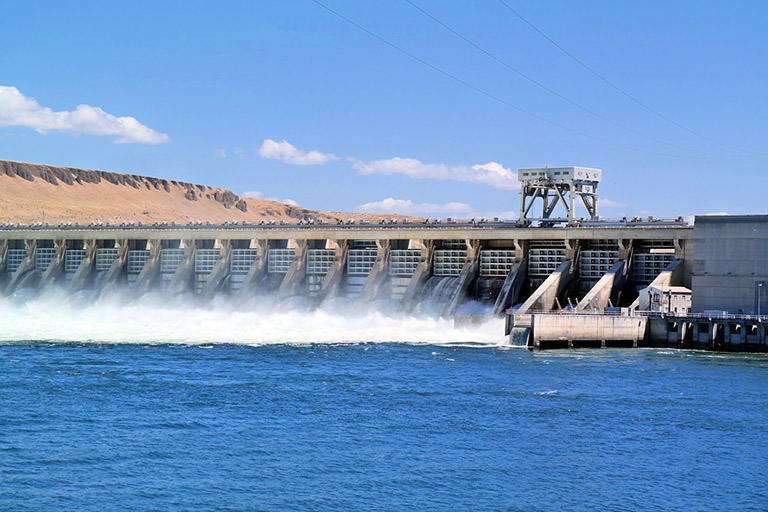
The Arunachal Pradesh State Pollution Control Board (APSPCB) recently conducted a public hearing for environmental clearance for the proposed 1,200 MW Kalai-II hydroelectric project, located on the Lohit River in Anjaw district, Arunachal Pradesh and developed by THDC India Limited.
- The project estimate is about ?14,000 crore, aiming to generate free power worth ?318 crore annually and contribute ?2.2 crore per year to the Local Area Development Fund upon commissioning.
- The public hearing, chaired by the Anjaw deputy commissioner, attracted over 350 affected persons from 33 villages. Discussions focused on compensation, employment guarantees, and land rates, with assurances that 50% of jobs would be reserved for land-affected families and that stakeholders’ issues would be addressed in accordance with policy.
- The project is expected to create approximately 1,700 direct jobs and improve local infrastructure, including roads, healthcare, and education.
- Some villagers have raised concerns about transparency in conducting the Environmental Impact Assessment (EIA) and Social Impact Assessment (SIA), and previously there have been protests regarding compensation and the large area of submergence that will directly affect up to 1,500 people from major villages, especially in the Hawai Circle.
- Officials highlighted that the initiative could bring long-term development benefits, citing similar hydropower projects like Uttarakhand’s Tehri Dam as examples. APSPCB officials explained the clearance process, and plans include exposure visits for affected village representatives to witness such infrastructure projects.
Capacity: 1,200 MW, with six turbines each of 190 MW.
Type: Run-of-river with pondage, using a concrete gravity dam.
Developer: THDC India Limited (formerly Tehri Hydro Development Corporation Limited).
Estimated Cost: ?14,000 crore.
Reservoir Capacity: 318.8 million cubic meters; gross head of 125 m.
Job Creation: ~1,700 direct jobs, 50% reserved for land-affected families.
Major Concerns: Communal transparency, land compensation, and disruption for affected villages.
The region remains divided, with most participants welcoming the project's development potential, but a section of villagers continues to express concerns over land rates, compensation, and employment guarantees. The environmental clearance process and final project approval will depend on the resolution of these issues and government compliance with regulatory norms.
Kalai-II Hydroelectric Project,FAQs
1. Which of the following statements about the Kalai-II hydroelectric project’s employment provisions is MOST accurate?
A) All jobs created will be offered exclusively to residents of Anjaw district.
B) Approximately 1,700 direct jobs will be created, with at least 50% reserved for families affected by land acquisition.
C) Employment guarantees were not discussed during the public hearing.
D) Only temporary construction jobs will be created, with no specific reservation for local families.
2. What is a primary concern raised by villagers regarding the Kalai-II hydroelectric project?
A) The project’s estimated cost exceeding ?20,000 crore.
B) Lack of transparency in Environmental and Social Impact Assessments and the large area of submergence affecting up to 1,500 people.
C) The use of outdated turbine technology that reduces power generation capacity.
D) Insufficient infrastructure development plans in sectors like healthcare and education.
Didayi Tribe
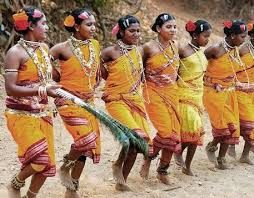
Champa Raspeda, a young woman from Odisha’s Malkangiri district, has become the first-ever member of the Didayi tribe—a Particularly Vulnerable Tribal Group (PVTG)—to clear the NEET 2025 exam. She has secured admission to Fakir Mohan Medical College & Hospital, Balasore, marking a landmark moment for her community.
- Inspiration and Support: Champa’s story is celebrated as one of resilience and community empowerment. Coming from a marginal farming background in Amlibeda village, she persevered through financial hardships, interrupted studies, and social challenges, aided by government initiatives, free NEET coaching, and her teachers.
- Community and Government Response: Odisha’s Chief Minister hailed her as an inspiration for tribal youth and expressed hopes that she would return as a doctor to serve the poor and backward people of her region. Her achievement symbolizes a breakthrough for the Didayi and other PVTGs in medical and higher education.
- Development Context: The Didayi tribe consists of around 9,800 people living in remote hill and forest villages of the Malkangiri district. Historically, they have faced challenges associated with poverty, low literacy, and lack of healthcare. Government schemes like the Didayi Development Agency (DDA) and support from the SC & ST Development Department have played crucial roles in tribal upliftment.
- Significance: Champa’s success follows similar milestones by members of other PVTGs (e.g., Mangala Muduli of the Bonda tribe). Such achievements signal a new chapter of empowerment, social transformation, and hope for Odisha’s most vulnerable tribal groups.
The Didayi Tribe (also spelled Didai, Didiya, or Dire) is an indigenous community primarily residing in the Malkangiri district of Odisha, with some presence in Koraput district (Odisha) and parts of East Godavari (Andhra Pradesh). They are recognized as a Particularly Vulnerable Tribal Group (PVTG)—one of 13 such groups in Odisha.
Location and Population
- Concentrated in the Kondakamberu ranges of the Eastern Ghats.
- Population estimates vary, ranging from ~7,250 to 8,890 individuals.
- They are found in about 42 remote hill settlements adjacent to streams, with scattered and bamboo-fenced houses.
- Language: Didayi (classified under Austroasiatic/Munda family).
- Racial stock: Proto-Australoid.
- Patriarchal society with a traditional village council (lepar) and elders managing disputes and sociopolitical affairs.
- Five totemic clans (bonso), which are exogamous; marriage practices include negotiation, elopement, intrusion, and service. Customs such as bride price, widow remarriage, levirate, and sororate are prevalent.
- Animistic beliefs with deep reverence for nature, earth, and a pantheon of gods and goddesses (e.g., Buro Bhairo, Nanagiri, Goa, Sendia, etc.).
- Numerous festivals and rituals: Lendi Pande, Bhairo Puja, Sibolove Hia, Goesendia Hia, Ghia Pande, Chait Parab, and more.
- Traditionally dependent on shifting cultivation (slash-and-burn) and wetland paddy farming.
- Supplementary livelihood by collecting and selling forest produce (fruits, roots, wood, mushrooms).
- Engaged in horticulture, kitchen gardening, bamboo basketry, weaving of handloom clothes, archery, and broom-making.
- Rich traditional arts and crafts, including bamboo work, weaving, pottery, painting, and vibrant music and dance, especially during community rituals.
- Night-time dances and locally brewed rice beer are part of their celebrations.
- The Didayi people consider the Bonda tribe as their elder brothers and the Gadaba and Paraja as close brethren.
- Their self-identity is "Gatare," meaning "the people".
- In 2025, Champa Raspeda became the first Didayi member to clear NEET, marking significant progress in education within the community.
- The Didayi tribe represents a unique blend of ecological adaptation, cultural richness, resilient social structures, and efforts to preserve their traditions in the face of modernization.
1. Which of the following best describes the social organization and marriage customs of the Didayi tribe?
A) Matriarchal society with monogamous marriages and strict endogamy within clans
B) Patriarchal society with exogamous totemic clans, including negotiated marriages, elopement, and customs like bride price and levirate
C) Egalitarian society with arranged marriages only and no practice of widow remarriage or sororate
D) Clanless society practicing polygamy and prohibiting any form of marriage negotiation
2. What is the significance of Champa Raspeda’s achievement in the context of the Didayi tribe and Odisha’s Particularly Vulnerable Tribal Groups (PVTGs)?
A) She became the first Didayi woman to win a national sports championship, inspiring tribal youth in athletics
B) She is the first member of the Didayi tribe to clear the NEET exam, symbolizing educational breakthrough and hope for medical and social upliftment of PVTGs
C) She led a government initiative to eradicate poverty in Malkangiri district through improved agricultural techniques
D) She documented the oral history of the Didayi tribe, leading to increased recognition of their cultural heritage
RBI Cautions Against Raising India’s 4% Inflation Target
The Reserve Bank of India (RBI) has recently released a discussion paper on its monetary policy framework cautioning against raising India’s current inflation target of 4%. The RBI warns that increasing the target now could undermine the credibility of the inflation targeting framework and risk reversing the macroeconomic stability and policy gains achieved over the past decade.
Key points from the RBI’s discussion paper and related news:
- RBI’s current inflation mandate sets a Consumer Price Index (CPI) target of 4% with a tolerance band of +/- 2%, forming the flexible inflation targeting (FIT) framework adopted since 2016.
- The RBI invites public feedback on four main aspects: whether monetary policy should focus on headline or core inflation; if the 4% target remains optimal for balancing growth and stability; whether the 2-6% tolerance band needs revision or removal; and if the fixed 4% target should be replaced by a range.
- The paper highlights that raising the inflation target above 4% amid current global geopolitical and economic uncertainties could be interpreted by investors as weakening the framework, thus hurting policy credibility and investor confidence.
- Lowering the target below 4% is also cautioned against, given India’s inflation dynamics and high global food prices.
- The RBI emphasizes that ignoring food inflation by targeting only core inflation (excluding food and fuel) risks overlooking the cost of living for poorer households.
- The FIT framework has proven effective, with average inflation reducing from 6.8% pre-2016 to 4.9% since. The system has shown resilience through the pandemic and global shocks, and the RBI seeks to retain the stability it offers.
- The government, in consultation with the RBI, will make the final decision on any modifications after the review scheduled for completion by March 2026.
- The RBI has invited feedback from stakeholders by September 18, 2025.
Overall, the RBI is signaling a preference to maintain the 4% inflation target rather than raising it, to preserve its monetary policy credibility and macroeconomic stability achieved since 2016. The discussion paper is part of a mandated five-year review of this inflation framework, seeking broader input on whether any adjustments are needed. The RBI emphasizes that the current framework’s success suggests retaining the 4% target with the existing tolerance band is prudent for India’s economic context.
Risks of Raising the Inflation Target
Risks of Raising the Inflation Target
- Raising the target now, amidst global geopolitical and economic uncertainty, might be interpreted as a dilution of the inflation targeting framework.
- It may signal weakening policy commitment, risking a loss of credibility with domestic and international investors.
- This loss of confidence could erode the policy and institutional gains, possibly destabilizing fiscal discipline and external economic stability.
- It might adversely affect foreign investment sentiment, as stable and low inflation is crucial for maintaining investment and growth.
Risks of Lowering the Inflation Target
- Lowering the inflation target below 4% is also considered potentially inappropriate.
- Given India’s structural economic characteristics, such as volatile food prices and external shocks, a lower target might not reflect realistic inflation dynamics.
- It could constrain monetary policy flexibility to respond to supply shocks and upward price pressures, especially in food and fuel.
- The RBI's assessment suggests that lowering the target may be hard to justify amid rising global food prices and inflation pressures.
Headline vs. Core Inflation in Monetary Policy:
- Headline Inflation measures the total inflation rate including all items in the consumer basket, notably food and fuel, whose prices tend to be highly volatile. It better reflects the overall cost of living for the population because it includes essential and frequently purchased items.
- Core Inflation excludes volatile food and fuel prices and is seen as a more stable measure of underlying inflation trends. It helps policymakers focus on persistent inflationary pressures rather than short-term fluctuations caused by external shocks.
In summary:
- RBI prefers to maintain the current 4% inflation target to preserve credibility and economic stability.
- The choice between headline vs. core inflation as the policy target involves weighing the volatility and welfare relevance of headline inflation against the stability and predictive value of core inflation.
- RBI is seeking stakeholder feedback on these issues to decide on the framework going forward, with a review due in March 2026.
This careful consideration highlights RBI's focus on balancing inflation control with growth stability, using a nuanced understanding of headline and core inflation indicators in monetary policy.
RBI Cautions Against Raising India’s 4% Inflation Target,FAQs?
1. According to the RBI’s discussion paper, what is the primary risk of raising India’s inflation target above 4% at this time?
A) It could lead to a rapid increase in food prices domestically.
B) It may be seen as weakening the inflation targeting framework, undermining policy credibility.
C) It would cause the RBI to lose control over interest rate adjustments.
D) It could result in a significant rise in unemployment rates.
2. Why does the RBI caution against targeting only core inflation instead of headline inflation in its monetary policy?
A) Core inflation includes volatile food and fuel prices, making it less stable.
B) Headline inflation excludes food and fuel prices, which are irrelevant to most households.
C) Ignoring food inflation risks overlooking the cost of living impacts on poorer households.
D) Core inflation is more affected by short-term external shocks than headline inflation.
RBI Cautions Against Raising India’s 4% Inflation Target,FAQs?
1. According to the RBI’s discussion paper, what is the primary risk of raising India’s inflation target above 4% at this time?
A) It could lead to a rapid increase in food prices domestically.
B) It may be seen as weakening the inflation targeting framework, undermining policy credibility.
C) It would cause the RBI to lose control over interest rate adjustments.
D) It could result in a significant rise in unemployment rates.
2. Why does the RBI caution against targeting only core inflation instead of headline inflation in its monetary policy?
A) Core inflation includes volatile food and fuel prices, making it less stable.
B) Headline inflation excludes food and fuel prices, which are irrelevant to most households.
C) Ignoring food inflation risks overlooking the cost of living impacts on poorer households.
D) Core inflation is more affected by short-term external shocks than headline inflation.
Haryana’s New Forest Definition Raises Environmental Concerns
Haryana Forest Definition Latest News
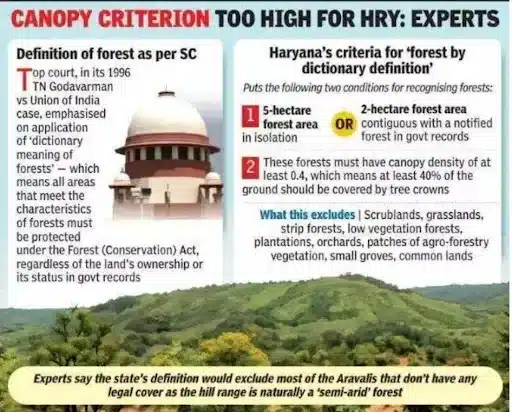
The latest news on Haryana’s forest definition, issued in August 2025, is that the Haryana government has officially defined "forest" under the “dictionary meaning” by a notification from the Environment, Forest and Wildlife Department. The definition requires that a forest patch must have:
- A minimum area of 5 hectares if isolated, or
- A minimum area of 2 hectares if contiguous with government-notified forests,
- And it must have a canopy density of at least 40% (0.4).
Exclusions from Definition
This new definition excludes
This new definition excludes
- Linear, compact, or agro-forestry plantations
- Orchards outside government-notified forests from being treated as forests.
Supreme Court’s Directives on Forest Definition
The Supreme Court of India has issued important directives related to the definition of "forest," primarily emphasizing the need to use the broad, dictionary meaning of the term rather than narrow or restrictive definitions.
Key points from the Supreme Court directives on forest definition are:
The Supreme Court of India has issued important directives related to the definition of "forest," primarily emphasizing the need to use the broad, dictionary meaning of the term rather than narrow or restrictive definitions.
Key points from the Supreme Court directives on forest definition are:
- The court reaffirmed the 1996 landmark judgment in the case of T.N. Godavarman Thirumulpad v. Union of India, which expanded the definition of forest to include all lands that resemble the dictionary meaning of forest. This includes all lands that may not be officially notified as forest but have forest-like characteristics, irrespective of ownership or record status.
- Expert committees: The Court directed all States and Union Territories (UTs) to constitute expert committees promptly to identify all "forest-like areas," "unclassified forest lands," and "community forest lands" within their jurisdiction using this broad definition. These committees are to conduct comprehensive surveys, mapping, and prepare reports on these forest areas.
- Survey and mapping:The survey and mapping process must comply with the 2011 Lafarge Umiam Mining guidelines. This includes using GIS-based decision support systems, and district-wise mapping of plots qualifying as forests under the Forest (Conservation) Act, 1980. It also includes identifying core, buffer, and eco-sensitive zones of protected areas, wildlife corridors, and lands diverted from forest use.
- States and UTs are required to submit the consolidated report of identified forest lands to the Central government within six months (or by March 31, 2024, as per latest timelines). These records will be digitized and made publicly available on official websites.
- The Supreme Court interim order in February 2024 also stayed the 2023 amendments to the Forest Conservation Act that had narrowed the definition of forests, restoring the broader 1996 definition.
- The Court underscored holding Chief Secretaries and administrators of States/UTs personally accountable for non-compliance with these directives.
- Recent notifications like Haryana's definition of forest reference the Supreme Court-directed dictionary meaning but have faced criticism for being too narrow and excluding ecologically sensitive but unclassified forest-like areas.
In summary, the Supreme Court’s directives firmly establish that the definition of forest for conservation law and policy purposes must be broad, consistent with the dictionary meaning as per the 1996 Godavarman ruling. States and UTs must identify, map, and report all such forest lands comprehensively, ensuring areas that are forest in essence but not officially notified are conserved and regulated under the Forest (Conservation) Act.
Reactions to Haryana’s Forest Definition
Reactions to Haryana’s new forest definition have been largely critical, especially from environmentalists and forest experts. The Haryana government recently issued a notification defining "forest as per dictionary meaning," with criteria such as a minimum area of 5 hectares if isolated (or 2 hectares contiguous with government-notified forests) and a minimum canopy density of 40%.
Key concerns raised include:
Reactions to Haryana’s Forest Definition
Reactions to Haryana’s new forest definition have been largely critical, especially from environmentalists and forest experts. The Haryana government recently issued a notification defining "forest as per dictionary meaning," with criteria such as a minimum area of 5 hectares if isolated (or 2 hectares contiguous with government-notified forests) and a minimum canopy density of 40%.
Key concerns raised include:
- The definition is seen as too narrow and restrictive, likely excluding ecologically important but low-density forest areas, especially in the Aravalli region known for its naturally sparse and thorny vegetation due to low rainfall and rocky terrain.
- Environmentalists argue the 40% canopy density threshold is unrealistic for the Aravallis and other dry regions of Haryana.
- The minimum area requirement (5 hectares or 2 hectares) is considered too high for a dry state like Haryana, potentially leaving smaller but ecologically critical forest patches without protection.
- The exclusion of linear, compact, agroforestry plantations, and orchards outside government-notified forests is also criticized as these plantations often have ecological functions.
- Critics also say this definition contradicts the 1996 Supreme Court Godavarman judgment which mandated a broad, dictionary-based interpretation of "forest" to ensure protection for diverse forest-like areas.
- Allied concerns include the risk of increased unregulated urbanization, illegal mining, and real estate encroachments in vulnerable forest regions like the Aravalli ridge.
- Some retired forest officers and experts have characterized the move as potentially supporting exploitative interests by excluding many important forest areas from legal safeguards.
The Haryana government states it has aligned its definition with judicial expectations and Supreme Court precedents, intending to use this to identify forest areas accurately for protection under the Forest Conservation Act. It also plans to form expert committees to identify forests as per this definition, with reports to be submitted to the Centre and subsequently to the Supreme Court.
Haryana’s New Forest Definition,FAQs?
1. According to the Haryana government’s latest forest definition issued in August 2025, which of the following criteria must a forest patch meet to be classified as a forest?
A) Minimum area of 3 hectares if isolated, with a canopy density of at least 30%
B) Minimum area of 5 hectares if isolated, or 2 hectares if contiguous with government-notified forests, and a canopy density of at least 40%
C) Any area with tree cover above 20%, regardless of size or contiguity
D) Only areas officially notified as forests by the government
2. What is one major criticism environmentalists have regarding Haryana’s new forest definition in relation to the Supreme Court’s 1996 Godavarman judgment?
A) It includes too many small forest patches with low ecological significance
B) It aligns perfectly with the broad dictionary meaning mandated by the Supreme Court
C) It is too narrow and excludes ecologically sensitive forest-like areas, contradicting the broad definition required by the Supreme Court
D) It removes the requirement for canopy density, leading to over-classification of plantations.
Haryana’s New Forest Definition,FAQs?
1. According to the Haryana government’s latest forest definition issued in August 2025, which of the following criteria must a forest patch meet to be classified as a forest?
A) Minimum area of 3 hectares if isolated, with a canopy density of at least 30%
B) Minimum area of 5 hectares if isolated, or 2 hectares if contiguous with government-notified forests, and a canopy density of at least 40%
C) Any area with tree cover above 20%, regardless of size or contiguity
D) Only areas officially notified as forests by the government
2. What is one major criticism environmentalists have regarding Haryana’s new forest definition in relation to the Supreme Court’s 1996 Godavarman judgment?
A) It includes too many small forest patches with low ecological significance
B) It aligns perfectly with the broad dictionary meaning mandated by the Supreme Court
C) It is too narrow and excludes ecologically sensitive forest-like areas, contradicting the broad definition required by the Supreme Court
D) It removes the requirement for canopy density, leading to over-classification of plantations.
NTCA Restricts Tiger Corridors to Minimal Pathways

Tiger Corridors Latest News
The National Tiger Conservation Authority (NTCA) has recently restricted the identification of tiger corridors to a minimal set of pathways known as the 32 "least cost pathways," originally identified in a 2014 report. This represents a significant policy shift from the previous broader definition that included multiple scientific studies and ecological benchmarks such as:
Protected areas occupied by tigers,
- Corridors in Tiger Conservation Plans (TCPs),
- Studies by the Wildlife Institute of India (WII) from 2016 and 2021,
- Quadrennial All-India Tiger Estimation (AITE) data.
Now, NTCA limits tiger corridors mainly to the 32 least cost pathways from 2014 and corridors recorded in specific tiger reserve TCPs, excluding many more recent and extensive scientific studies and data.
Importance of Tiger Corridors
Importance of Tiger Corridors
- Tiger corridors are vital for the safe movement of tigers between habitats, enabling gene flow, maintaining genetic diversity, reducing human-animal conflicts, and ensuring long-term survival.
- This move by NTCA simplifies project clearances for development by easing the requirement for statutory clearance from the standing committee of the National Board for Wildlife (SC-NBWL) for projects falling outside these minimal pathways.
However, conservationists have expressed concern. Restricting corridors to minimal pathways underestimates the complexity of tiger movement. A recent study by Nagpur's LRC Foundation highlighted 192 potential corridors across 10 central Indian states, showing a much denser and biologically important network beyond the 32 pathways. The NTCA’s 2014 report itself called the least cost pathways a "minimal requirement" and acknowledged the existence of alternative connectivities that need conservation.
This policy reversal has implications for tiger conservation, especially as India's tiger population recovers but faces increasing habitat fragmentation. It risks prioritizing short-term development over long-term ecological connectivity and genetic viability of tiger populations.
The issue is currently under judicial scrutiny, with the Bombay High Court hearing a petition challenging Maharashtra's decision to enforce NTCA's minimal corridor definition. The NTCA is reportedly working on refining corridor maps but has indicated that further updates may be postponed until court rulings are finalized.
In summary, NTCA has restricted tiger corridors to a narrower definition focusing on minimal pathways to ease project clearances, which has raised ecological and conservation concerns regarding the long-term viability of tiger populations and habitat connectivity in India.
NTCA Restricts Tiger Corridors to Minimal Pathways,FAQs
1. What is the primary change in the National Tiger Conservation Authority's (NTCA) recent policy on tiger corridors?
A) Expanding tiger corridors to include all protected areas occupied by tigers
B) Restricting tiger corridors to the 32 "least cost pathways" identified in 2014 and specific Tiger Conservation Plans (TCPs)
C) Eliminating the use of the 2014 report and relying solely on the latest Wildlife Institute of India studies
D) Increasing the number of tiger corridors based on the latest All-India Tiger Estimation data
2. What is a major concern raised by conservationists regarding NTCA's restriction of tiger corridors?
A) It will lead to an immediate increase in human-tiger conflicts due to reduced habitat space
B) It oversimplifies the complexity of tiger movement by ignoring numerous potential corridors beyond the minimal pathways
C) It will cause the tiger population to exceed the habitat’s carrying capacity
D) It prioritizes tiger conservation over developmental projects, causing economic loss
This policy reversal has implications for tiger conservation, especially as India's tiger population recovers but faces increasing habitat fragmentation. It risks prioritizing short-term development over long-term ecological connectivity and genetic viability of tiger populations.
The issue is currently under judicial scrutiny, with the Bombay High Court hearing a petition challenging Maharashtra's decision to enforce NTCA's minimal corridor definition. The NTCA is reportedly working on refining corridor maps but has indicated that further updates may be postponed until court rulings are finalized.
In summary, NTCA has restricted tiger corridors to a narrower definition focusing on minimal pathways to ease project clearances, which has raised ecological and conservation concerns regarding the long-term viability of tiger populations and habitat connectivity in India.
NTCA Restricts Tiger Corridors to Minimal Pathways,FAQs
1. What is the primary change in the National Tiger Conservation Authority's (NTCA) recent policy on tiger corridors?
A) Expanding tiger corridors to include all protected areas occupied by tigers
B) Restricting tiger corridors to the 32 "least cost pathways" identified in 2014 and specific Tiger Conservation Plans (TCPs)
C) Eliminating the use of the 2014 report and relying solely on the latest Wildlife Institute of India studies
D) Increasing the number of tiger corridors based on the latest All-India Tiger Estimation data
2. What is a major concern raised by conservationists regarding NTCA's restriction of tiger corridors?
A) It will lead to an immediate increase in human-tiger conflicts due to reduced habitat space
B) It oversimplifies the complexity of tiger movement by ignoring numerous potential corridors beyond the minimal pathways
C) It will cause the tiger population to exceed the habitat’s carrying capacity
D) It prioritizes tiger conservation over developmental projects, causing economic loss

