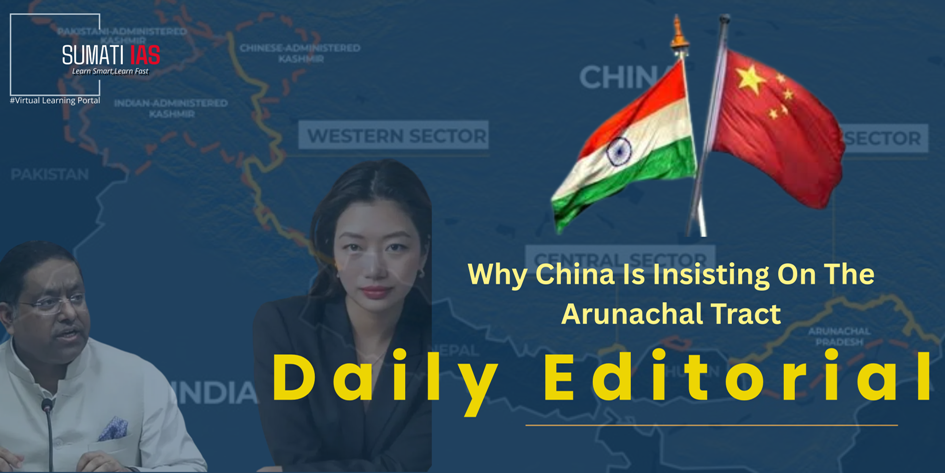
Why China Is Insisting On The Arunachal Tract
In late November 2025, Chinese officials detained an Indian national from Arunachal Pradesh at a border point, rejecting her Indian passport and insisting she was from Chinese territory, sparking a diplomatic spat.
Historical Background
- Simla Convention (1913-1914): British India, Tibet, and China met in Simla to define Tibet's boundaries; the convention divided Tibet into inner and outer regions under Chinese suzerainty while setting the India-Tibet border.
- McMahon Line Creation: Sir Henry McMahon, British Foreign Secretary, negotiated the 890 km line with Tibetan representative Lonchen Shatra via notes exchanged on March 24-25, 1914, in Delhi, placing Arunachal (then NEFA) under British India; this was initialled on April 27 and formalized July 3, 1914.
- China's Non-Ratification: Chinese delegate Ivan Chen attended but refused to sign, objecting to Tibetan autonomy and Article 9 on inner-outer Tibet divisions, deeming the line illegitimate as Tibet lacked independent treaty-making power.
- Tibetan Acceptance with Conditions: Tibet signed bilaterally with Britain after China's refusal, but considered the line invalid without Chinese endorsement; Britain and Tibet proceeded without China, attaching notes denying Beijing privileges.
- Pre-1914 Context: British interest grew post-1826 Anglo-Burmese War for Assam security and trade; Tibet held de facto control over areas like Tawang until 1951.
- Post-Independence Disputes: India inherited the line in 1947; China annexed Tibet in 1950, rejected the boundary, leading to 1962 war incursions.
China's tactics and strategic reasons
- China uses "Three Warfares" strategy—legal, psychological, and media warfare—by renaming 89 places in Arunachal Pradesh with Mandarin names to create a paper trail supporting its territorial claims and to influence public perception and diplomatic arguments over time.
- Renaming and map changes form part of "cartographic aggression" and a precursor to incremental encroachment or salami-slicing tactics, allowing China to assert claims stepwise without triggering full-scale conflict, similar to its strategy in the South China Sea.
- Diplomatic provocations like stapling visas on Arunachal residents' Indian passports and detaining them at Chinese transit points aim to delegitimize India's sovereignty over Arunachal and pressure its citizens.
- Militarily, China aims to exert pressure at the Line of Actual Control by approving infrastructure projects like dams near the border, while India counters with its own projects, reflecting ongoing competition for territorial control and influence.
- Strategically, Arunachal Pradesh is important for India as a link to Southeast Asia and holds religious significance for China as part of its claimed extension of Tibet, especially the area near Tawang Monastery, birthplace of the sixth Dalai Lama. This adds symbolic weight to Beijing's claims.
- China's actions also coincide with broader geopolitical maneuvers, including countering India’s relations with Western powers and maintaining leverage in the Indo-Pacific region through the Quad and other alliances.
- These tactics form part of China's larger objective to challenge India's control over Arunachal Pradesh gradually while avoiding large-scale war, ensuring strategic advantage in this sensitive border region.
Way Forword
Diplomatic Pathways
- Resume Special Representatives talks, paused amid LAC standoffs but key for addressing Arunachal claims, alongside Working Mechanism for Consultation and Coordination meetings to build trust through de-escalation.
- Leverage recent post-Galwan disengagements (completed October 2024 in eastern Ladakh) as a model, extending patrolling agreements and buffer zones to Arunachal sectors.
- Involve multilateral forums cautiously, with India strengthening Quad partnerships for strategic balance without provoking Beijing, while both sides avoid renaming or map provocations per 2005 principles.
Infrastructure and Internal Measures
- India accelerates border development via Border Roads Organisation, including roads, bridges, and forward bases in Arunachal, to assert sovereignty without altering LAC status quo.
- Enhance people-to-people ties through border trade points and confidence-building measures, safeguarding settled populations as per bilateral pacts.
Long-Term Resolution
Final settlement requires mutual recognition of LAC, historical evidence review, and addressing sensitivities like Tawang, but immediate focus remains on tranquility amid 2025 diplomatic spats.
Conclusion
India maintains effective control and sovereignty, rejecting claims as baseless while bolstering infrastructure and diplomacy.
Resolution demands mutual de-escalation via Special Representatives talks, LAC patrolling pacts, and adherence to 2005 boundary principles, prioritizing tranquility over maximalist positions amid 2025 tensions.
Download Pdf


Get in Touch