Blood Moon
Why in news?
The Blood Moon occurred on the night of September 7-8, 2025, and featured one of the longest totality phases of the decade, lasting about 82 minutes.
What Is a Blood Moon?
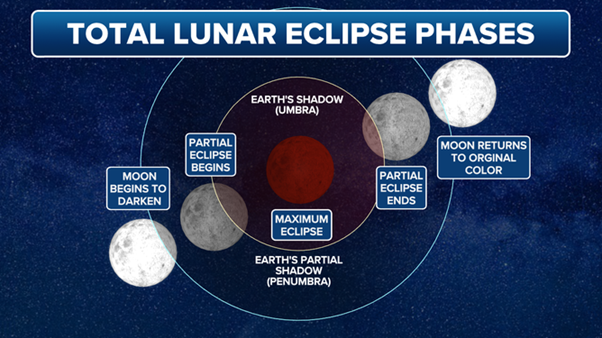
- A blood moon occurs during a total lunar eclipse, when the Earth passes directly between the Sun and the Moon.
- The Earth’s shadow (the umbra) completely covers the Moon, but instead of going completely dark, the Moon glows red or copper due to sunlight filtering and scattering through Earth’s atmosphere, a process known as Rayleigh scattering.
- The Moon appears red as Earth’s atmosphere scatters blue light and allows red and orange wavelengths to bend and reach the Moon’s surface.
- This phenomenon only happens during a full moon when the Sun, Earth, and Moon align perfectly.
- Lunar eclipses occur about twice a year, but total lunar eclipses (blood moons) are less frequent, happening about once every 1–3 years globally.
- Only about 4–5 total lunar eclipses are visible from any single location per decade.
- The September 2025 blood moon was visible to roughly 77% of the world’s population, especially across Asia, Africa, Europe, and Australia, making it an exceptionally accessible event.

